This article is based on observations of common beginner TikTok growth strategies, platform behavior patterns, and content reuse risks frequently discussed among creators and e-commerce sellers. It reflects practical insights into how TikTok treats copied content and how beginners can reuse content more safely and effectively.
 +
+
Intro: Everyone Copies on TikTok… Right?
If you spend enough time on TikTok, you’ll notice something quickly:
The same videos.
The same hooks.
The same products.
So beginners naturally ask:
“If everyone is copying, is it actually safe?”
The short answer is: sometimes.
The long answer is what really matters.
Section 1: Why Beginners Copy TikTok Videos in the First Place
Let’s be honest—copying feels smart.
For beginners, copying means:
- Less thinking
- Less risk
- Faster posting
You see a video go viral and think:
“If it worked for them, it should work for me.”
And sometimes… it does.
But TikTok does not reward copying equally.
Section 2: How TikTok Detects Copied Content
TikTok is much smarter than it looks.
It can analyze:
- Video frames
- Audio patterns
- Text overlays
- Posting behavior
If your video is too similar, TikTok may:
- Limit initial distribution
- Reduce reach silently
- Categorize your account as “low originality”
- No warning. No notification. Just fewer views.
That’s why many beginners feel “shadowbanned” without knowing why.
Section 3: Copying vs Reusing — A Critical Difference
There is a big difference between copying and reusing.
Copying usually means:
- Same script
- Same visuals
- Same structure
Reusing means:
- Same idea
- Different execution
- New context
TikTok rewards ideas, not clones.
Section 4: When Copying Can Still Work (For Beginners)
Copying isn’t always bad.
It can work when:
- You change the opening hook
- You use your own footage
- You adapt it to a different audience
- You add explanation or context
The more value you add, the safer it becomes.
Section 5: The Hidden Risk Beginners Don’t See
The biggest danger of copying is not bans.
It’s learning nothing.
If you only copy:
- You don’t understand why a video worked
- You can’t repeat success
- Growth becomes luck-based
That’s why many copied videos get views once—and never again.
Section 6: How Smart Beginners Reuse TikTok Content (EEAT)
Experienced sellers and creators reuse content strategically.
They analyze:
- Which part made people comment
- Which moment triggered shares
- What problem viewers reacted to
Then they rebuild the video around those signals.
This is where tools like KOLSprite become useful—not for copying, but for understanding why something works.
Section 7: Using Data Instead of Guessing
Instead of copying blindly, beginners can:
- Download high-performing videos
- Study pacing and structure
- Compare different creators’ approaches
- Identify repeatable patterns
This turns copying into learning.
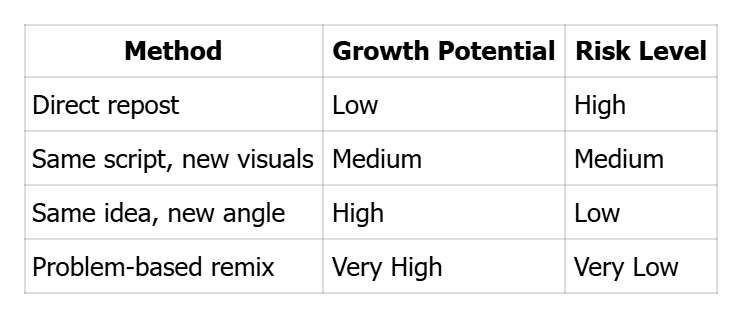
Table: Copying Methods vs TikTok Risk Level
 +
+
Section 8: A Better Beginner Strategy
If you’re just starting, aim for:
- 30% inspiration
- 70% originality
That balance keeps your account safe and sustainable.
TikTok rewards creators who evolve, not those who repeat.
Final Takeaways
- Copying is common, but risky
- TikTok detects similarity better than you think
- Reusing ideas is safer than copying execution
- Learning beats shortcuts
- Data-driven reuse beats blind imitation
CTA
Want to reuse TikTok content the smart way? Use KOLSprite to analyze what actually works before you recreate it.


 Refer & Earn